
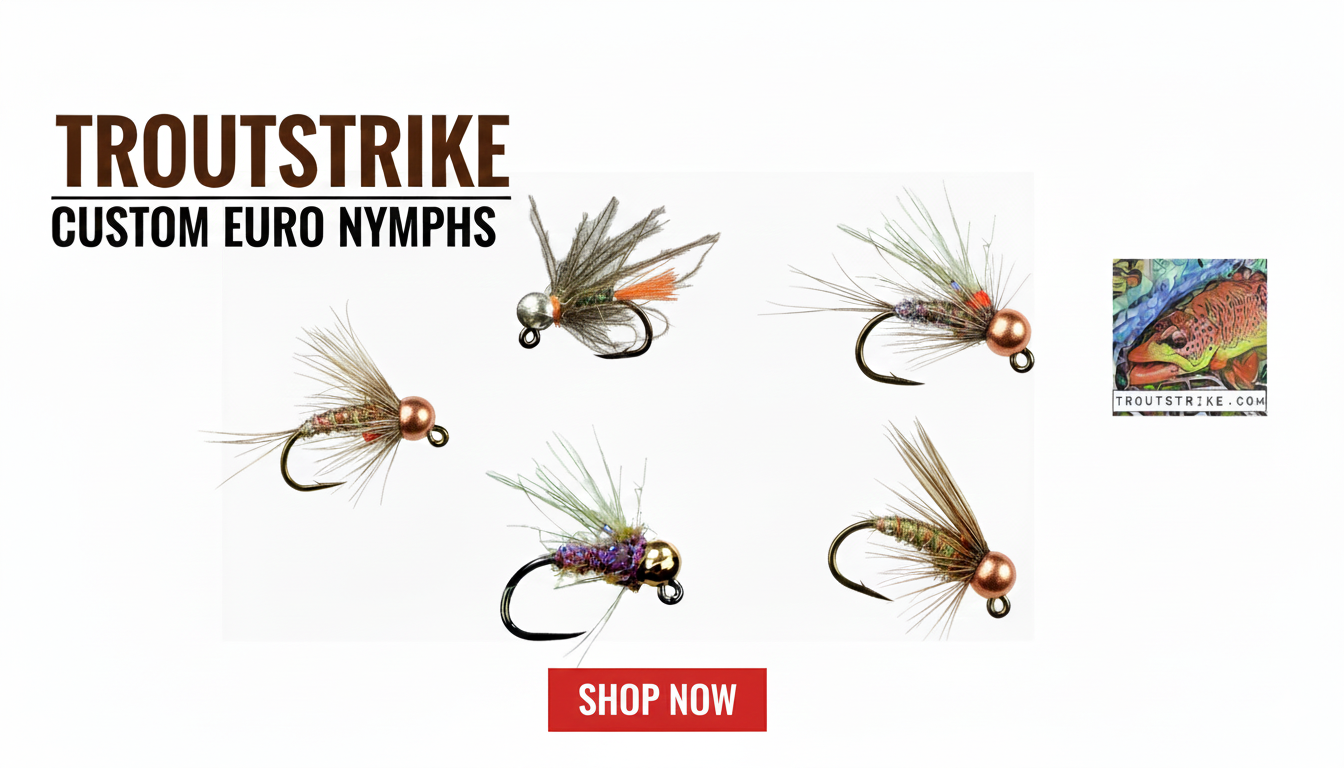

Euro nymphing flies are heavily weighted and designed to sink quickly. It is important to know the weight of the euro nymphing flies you are using, as you need to make frequent adjustments based on the depth and speed of the water you are fishing. If your nymphs are too heavy for the water type you are fishing, they will get hung up on the bottom and disrupt your drift. If your nymphs are too light, they will not get down to the fish. I created this post to share my strategy for weighting and organizing euro nymphing flies, helping you develop a system that makes it easy to adjust when out on the water.
Tying Euro Nymphing Flies
For the majority of the euro nymphing flies I tie, I use jig hook ranging from size 12 to 20. I pair the jig hook with slotted tungsten beads in a variety of weights. It is important to know the weights of the tungsten beads your flies are tied with and have a system to easily identify them when you are fishing.


My euro nymphs are simple patterns. I use simple patterns because I have confidence in them. Confidence comes from catching fish consistently on a pattern. My boxes are filled with variations of Walt’s worms, frenchies, perdigons, and other proven patterns.

Focus on Getting Weight into Your Euro Nymphing Flies
Getting weight into your euro nymphing flies is essential in your presentation. Most often, trout are feeding in the “strike zone,” that 12-18 inch space from the bottom. The current in the strike zone is slower than the flow above it. So to get your flies drifting in the strike zone, you have to put weight into your nymphs to slice through the heavier current above. Also, having weight in your nymphs helps you to stay in contact with them so that you can monitor your drift and better detect strikes. Josh Miller does a much better job of explaining this. Check it out.
Euro Nymphing Fly Organization Helps You Change for Conditions
Euro nymphing is as dynamic as the rivers we fish. The speed and depth of the water is always changing. So it is essential to have nymphs in a variety of weights. This is why I focus less on the patterns I’m fishing and more on the weight of the nymphs. Therefore, I often tie the same pattern in a variety of sizes and weights.
Create Combinations of the Same Pattern
One of my favorite patterns is the UV Thread Frenchie. It can be tied in any combination of colors you like. My confidence color for this pattern is an olive thread, dark green wire, with a pink ice dub hot spot. Some size combination of this pattern is usually on my rig through the major mayfly hatch season (March-June). There have been times when every trout I caught on a given day during that stretch was on this pattern. The diagram below shows this pattern tied with three different-sized beads, but all on a size 16 jig hook. Using jig hook with slotted tungsten beads allows me to undersize and oversize a fly.

When I first started tying, I tried to make everything proportional. I thought the over-weighted flies looked odd. What I learned, however, is that the trout don’t think they look odd at all. They eat them just fine.
Organizing By Bead Size
When it comes to organizing the flies, I have found that using small boxes loaded with bugs, each with one-sized bead, works for me. I tend to use the three sizes shown in the photo (3.2, 2.8, and 2.4) most often. So I carry a box of each. During high water or when fishing in really fast currents, I will use beads larger than 3.2. Likewise, I will sometimes go down to beads as small as 2.0 mm or 1.5 (I love these on dry/dropper rigs). But I don’t feel like I need to carry as many. That’s just what works for me.
Create a System that Works for You
The critical concept here is having an organizational system that allows you to easily increase or decrease the weight of your rig by simply changing your files. You will want a system that lets you easily distinguish between sizes. I keep it simple by thinking of it in terms of small, medium, or large (2.4 mm, 2.8 mm, 3.2 mm). From time to time, I need an XS (2.0 mm) or an XL (4.0 mm) for high water or low water.
However you choose to organize your nymphs, the most important step is to identify your confidence bugs and have them tied in a variety of weights. By focusing less on the pattern and more on the weight, you will spend more time getting consistent drifts and netting more trout.


I’m just getting started tying some Euro flys great advice on weight on flys! Now I can get started in tying.
Sal,
Thanks for reading! Best of luck tying!
Tight Lines,
Jeff